Security holes in hospital software, and how MedBrains closes them
Where security holes in hospital software come from, how MedBrains closes them as one system, what we fixed recently, and what is not done yet.
On this page
In short: Most hospital breaches start at a seam: an unpatched part, a shared password, a lost machine or a bad key. MedBrains is one program on one database, with its own operating system and one signed update path, so there are fewer seams, and each layer refuses rather than warns. We publish what we fix. MedBrains has not had an outside penetration test yet, and we say so.
Hospitals are attacked for a plain reason: they cannot stop. A bank can close a branch for a day; a ward cannot close. Records are valuable, the pressure to pay a ransom is high, and the systems are often old, many, and joined by hand.
This post is for owners, administrators and IT heads. It explains where breaches in hospital software usually start, what we mean when we say MedBrains is built as one tightly integrated system, and what each layer is there to stop. Every claim below is about code that is in our public repository today. Where something is not finished, we say so.
Where breaches usually start
Very few breaches begin with a clever new technique. Most begin at a seam, somewhere two parts meet and each assumes the other is guarding the door.
- A part nobody patched. A typical hospital system is several products: an application, a database, a reporting tool, a print server, an interface engine. Each has its own updates, and the one that was missed is the way in.
- Systems stitched together. Every interface between two products carries a password or key, a network port and a set of assumptions. The more products, the more of those there are, and the fewer anyone can list.
- Shared and default passwords. One administrator login used by four people, or a vendor password that was never changed, turns one leak into full control.
- A lost laptop or a stolen server. If the disk is not encrypted, whoever holds it holds the records. Backups copied to a USB drive are the same problem in a smaller box.
- A bad key. A signing or encryption key that was cut short, copied into the wrong place or left at a published default can look as if it works for months. Keys generated by the certificate authority eMudhra were found to be weak, and the certificates built on them had to be distrusted.
- The supply chain. Software is built from hundreds of open-source pieces. A known flaw in one of them, or a tampered build step, reaches every customer at once.
What “tightly integrated” means here
The usual answer to each of those problems is another product: an antivirus, a patch manager, a key vault, a backup tool. Each closes a gap and adds a seam.
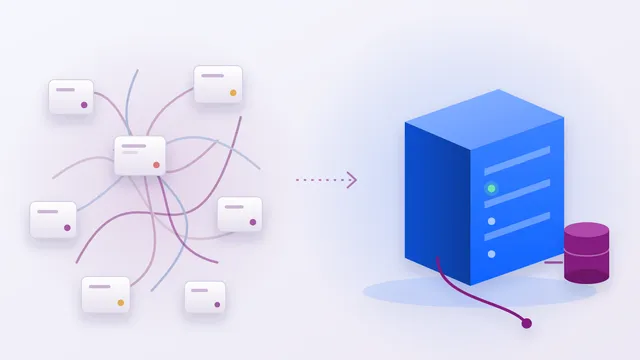
MedBrains goes the other way. It is one compiled program that serves every module, on one PostgreSQL database. For hospitals that want an appliance, there is also the MedBrains operating system: a small Linux system we build ourselves, with the database, the server and its front door on it and nothing else. It is built directly on Linux with no Docker inside it, so there is no container layer to patch separately. Updates come down one signed path.
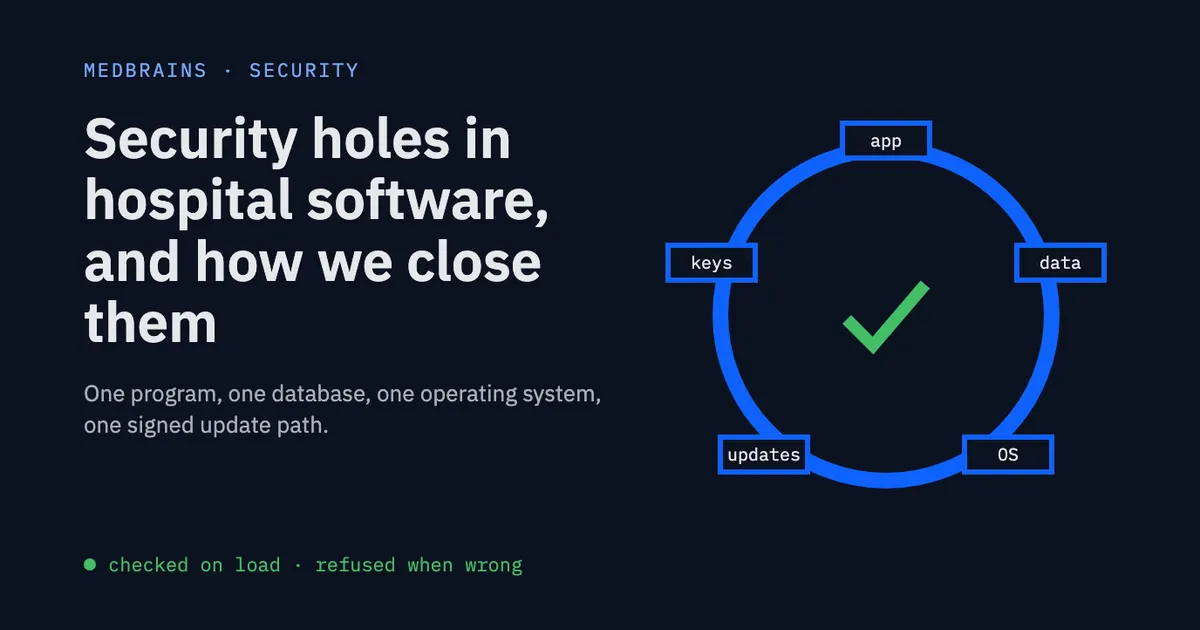
One program, one database, one operating system and one update path means fewer places where two parts can disagree about who is responsible. It does not mean nothing can go wrong. It means the list of things to check is short enough to be checked.
The layers, and what each one stops
The database refuses to mix hospitals
Every table that holds a hospital’s identifier has PostgreSQL row-level security switched on. Each request sets its hospital inside its own database transaction, and the database then refuses to return another hospital’s rows, even if a mistake slips into the application code above it. A check in our continuous integration fails any change that adds such a table without that protection.
What it stops: one hospital’s data showing up in another’s screens, through a bug rather than an attack.
Every action is checked on the server
Permissions are defined once, in the server’s own code, and the list the screens use is generated from it, never written by hand. The server checks the permission on each request; hiding a button is a courtesy, not the control. Repository checks fail a screen that is gated on a permission no server route enforces.
An authorisation check has three answers, not two: allowed, refused, or unknown, for when the check itself failed because something was down. Unknown is treated as refused at the edge, so a fault never quietly grants access. And the reverse rule matters just as much in a hospital: a list that could not be checked must never be shown as an empty list, because a blank ward reads as a fact about the ward. A check in our continuous integration fails code that turns an authorisation error into a plain “no”.
What it stops: a user reaching data through a route nobody guarded, and an outage being mistaken for “no patients”.
Sign-in is hard to guess and hard to reuse
Passwords are stored with Argon2id. Five wrong passwords lock an account for 15 minutes, and every failure is audited. Signing a clinical record needs the password again within five minutes, so a session left open on a ward computer cannot sign in a doctor’s name. Signed prints carry a QR code that lets an insurer, court or another hospital check that the record is genuine and unchanged, without seeing any clinical content.
When a hospital signs staff in through its own identity provider, an email address finds a local account only if the provider says it verified that address. On the MedBrains operating system, staff identity runs on Kanidm, pinned to an exact version, with staff set to sign in with security keys by default so that guessing a password gets nobody in.
What it stops: password guessing, an unattended session signing records, and a forged or altered printout passing as real.
The audit trail cannot be edited
Audit records are append-only: the database refuses any change or deletion, whoever asks. Each hospital’s audit log is also hash-chained, every entry linked to the one before it, so an edit by someone able to switch the database’s protections off still shows when the chain is checked. Password hashes, sign-in secrets and recovery codes are kept out of the log.
What it stops: an insider covering their tracks, and the audit log itself becoming a place to steal credentials from.
Keys are checked when they are loaded
This is the newest layer; the section on recent fixes below says how it came about. Every key now passes through one place that checks it before use:
- a key’s length is checked, and a key made of one repeated byte is refused;
- a private key must produce the public key it is paired with, and a test signature is made and verified before the key is trusted;
- the server refuses to start if its sign-in key pair does not match, instead of starting and failing every sign-in later;
- one rule decides every key the server uses to seal stored secrets, and the development key in our public code is used only on a machine marked as development; any other setting, including a typo, is treated as production;
- the signature code is tested against the published test values in RFC 8032, the standard for the signatures we use;
- a repository check fails new code that builds keys from raw bytes outside that one place.
Separately, production refuses to start with default passwords or with keys whose values are published in our repository, and the installer generates real ones.
What it stops: a damaged, mismatched or published key being used as if it were sound.
The program is written to fail safely
The server is written in Rust, with unsafe code forbidden across the whole
workspace. That rules out a family of memory errors behind many serious flaws in
older software. Our build rules also refuse code that could crash the server on
an unexpected value, so an error has to be handled, not ignored.
What it stops: whole classes of memory bugs, and crashes that become outages.
Dependencies are checked on every change
The lockfiles that fix the exact version of every open-source piece are kept in
the repository. On every change, continuous integration runs cargo audit and
cargo deny for the Rust code and pnpm audit for the web code, and these block
a change with a known high-severity flaw. A dependency review blocks a pull
request that adds a high-severity flaw. GitHub’s CodeQL analyses the code,
TruffleHog looks for real leaked secrets, and OSV-Scanner, Checkov and zizmor
check the other lockfiles, the infrastructure code and the build workflows
themselves; those three report findings for now and become blocking once their
backlogs are cleared.
The build workflows pin every third-party action to an exact commit, so a hijacked version tag cannot run code in our builds, and each workflow starts with read-only access. Each change to the main branch keeps a software bill of materials. The release pipeline signs container images and checksums with cosign and attaches the bill of materials and build provenance.
What it stops: a known flaw in a dependency reaching a hospital unnoticed, and a tampered build step.
Backups are sealed before they leave the machine
The installer sets up a nightly database backup. Before a copy leaves the machine it is encrypted to a public key whose private half is kept offline, and without that key file in place the backup refuses to send anything. A restore drill script proves the backups actually restore.
What it stops: a stolen backup being readable, and a backup that was never tested failing on the day it is needed.
The operating system protects the disk and its own updates
On the MedBrains operating system, the data partition, which holds the database, secrets, files and logs, is encrypted with LUKS2. It is created encrypted on first boot, so no plain copy ever exists. Its key is sealed to the machine’s TPM chip and tied to how the machine starts. A recovery key is shown once, and a start-up PIN is optional. A machine with no TPM stops and asks rather than storing patient data unprotected. Each machine makes its own keys on first boot, so two machines from the same image share no secret.
Updates arrive as whole signed images written to a second slot, never over the running system. The machine starts the new version on trial, checks that the database, server and front door are healthy, and goes back to the old version by itself if they are not. In our virtual-machine tests, tampered and rolled-back updates are refused. The same signed bundle can arrive on a USB stick for a hospital with no internet link.
The firewall refuses everything in both directions unless it is listed, and the database answers only its own machine.
What it stops: a disk taken out of the machine being read, an update that fails leaving the hospital without a system, and a forged update being installed.
What we fixed recently, and how we found it
Every system has flaws. What matters is how fast they are found and how openly they are fixed. Two recent examples, without the details an attacker would want.
Seven dependency alerts, fixed on 11 November 2026. The most serious was in
certifi, the list of trusted certificate authorities used by our Python test
tools. It still trusted intermediate certificates from eMudhra’s emSign whose
keys had been generated weak (advisory GHSA-6q48-6c7w-9gw2, rated critical). We
moved to the release that drops them. The same change updated idna
(GHSA-65pc-fj4g-8rjx), node-forge and fast-xml-parser for medium and
low-severity advisories. Two alerts are not fixed yet, and we say so: glib,
which arrives through the graphics toolkit on our operating system’s screen
and needs a larger toolkit upgrade, and rsa, which has no fixed release and
appears only in a test helper for the operating system.
Our own key handling, fixed on 12 November 2026. After reading about the eMudhra weak-key incident, we asked whether our code would notice a damaged key. Our own review found that it would not: every loader trusted its bytes. Some modules could also fall back to the development key that is published in our repository on any machine not set exactly to “production”, such as a staging server or a mistyped setting, and would then seal hospital secrets with a public key. That is now one rule: anything not explicitly marked as development is production. Sign-in key pairs and doctors’ signing keys are checked before use, keys from partner systems must be valid points on the expected curve, and a repository check stops new code handling raw keys. This was found by our review, not by an incident; the key layer above lists the checks.
How we find them. Scanners run on every change: cargo audit and
cargo deny, pnpm audit, OSV-Scanner, CodeQL and a secrets scan, and GitHub’s
Dependabot alerts tell us when a new advisory touches something we use.
Security changes get an independent review before they merge; the signing
changes in November were reworked after one. And we read other vendors’
incidents and ask whether the same mistake is in our code, as with eMudhra.
How a hospital gets the fix. On the MedBrains operating system, fixes arrive as signed updates that roll back by themselves if the new version is not healthy. Our security release process sets the timelines, critical within 72 hours, and how advisories are published. If you find a vulnerability, please report it privately as our security policy describes, not in a public issue.
What we do not claim yet
Honesty about gaps is part of security. Today:
- No outside penetration test yet. Our threat list requires one before the MedBrains operating system goes live in a hospital.
- No security certification. We do not hold ISO 27001, SOC 2 or similar.
- The operating system is not in a hospital yet. Its disk encryption and signed updates are built and tested in virtual machines.
- A stolen machine is not fully covered without a PIN. Someone who can alter the system partition of a machine that unlocks by itself can get in. A PIN closes that now. Coming next: a sealed, read-only system partition, and further hardening of the kernel, services and the TPM against power cuts.
- The update signing key is not yet held offline on hardware, and the check of each machine’s parts list against known flaws is not built.
- Three scanners report but do not yet block, as described above.
We keep the full list, with the test that would close each item, in our public threat document.
A checklist to use with any vendor
You can ask these of us or of anyone else. A good vendor answers each with evidence, not a brochure.
- How many separate products make up your system, and who patches each one?
- Where is hospital separation enforced: in the database, or only in the application?
- Is every permission checked on the server, and what does a screen show when the check itself fails?
- Can your audit log be edited by a database administrator? How would we know?
- Is the disk encrypted from the first boot, and who holds the recovery key?
- Are backups encrypted before they leave the server, and when did you last prove a restore?
- How are updates signed, and what happens if one fails half-way?
- What do you do when a key is damaged or does not match? Warn, or refuse?
- Can we see a software bill of materials, and how fast do you fix a critical flaw?
- When was your last independent penetration test, and can we see the summary?
The short version
Most security holes start at a seam between products. MedBrains is one program on one database, with its own small operating system and one signed update path, so there are fewer seams to start from. Each layer is built to refuse: the database refuses the wrong hospital’s rows, the server refuses unchecked actions, the audit log refuses edits, and the key loader refuses a bad key. We have not had an outside penetration test yet. When we fix a flaw, we say what it was and how we found it.
If your IT team would like to go through this list against the code itself, book a demonstration and we will walk them through it.
Frequently asked questions
Has MedBrains had an independent penetration test?
Not yet. Our own threat list puts an outside penetration test before the MedBrains operating system goes live in any hospital, and we will publish when it has happened. Until then, treat our controls as tested by us, not by an independent party.
Does MedBrains hold a security certification such as ISO 27001 or SOC 2?
No. We hold no security certification today. What we can show is the code itself, which is public, the automated checks that run on every change, and a written list of what is still open.
What happens if someone steals a MedBrains machine or its disk?
On the MedBrains operating system the data partition is encrypted from first boot and its key is sealed to the machine's TPM chip. A disk taken out and read elsewhere does not open without the recovery key, and that is tested. A whole stolen machine is harder: without a start-up PIN, someone able to alter its system partition can still get in. A PIN closes that today, and a sealed, read-only system partition is the next piece of work.
Can our IT team check what is inside MedBrains?
Yes. The source code is public, every change on the main branch keeps a software bill of materials in the CycloneDX format, and the release pipeline signs container images and checksums with Sigstore cosign and attaches the bill of materials, so your team can verify what it installs.
Does this help with data protection laws?
It helps, but no software makes a hospital compliant by itself. Laws such as the EU's GDPR, HIPAA in the United States or India's DPDP Act expect access control, audit trails and breach response. MedBrains provides the controls; the hospital still owns consent, retention and how it responds to an incident.
Sources
- PostgreSQL 17 documentation. Row Security Policies postgresql.org
- systemd. systemd-cryptenroll, enrolling TPM2 keys for LUKS2 volumes freedesktop.org
- systemd. systemd-boot automatic boot assessment systemd.io
- IETF RFC 8032. Edwards-Curve Digital Signature Algorithm (EdDSA) rfc-editor.org
- Sigstore. Cosign, signing and verifying software artefacts docs.sigstore.dev
- CycloneDX. Software bill of materials standard cyclonedx.org
- OSV. Open source vulnerability database and scanner osv.dev
- Kanidm. Identity management platform kanidm.com
- The Rust Reference. The unsafe keyword doc.rust-lang.org